Your AI Doesn't Actually Know Anything. Here's What It's Really Doing.
Most people use AI tools every day without thinking much about how they actually work. That's fine, until the moment it isn't. And for a lot of teams, that moment is arriving faster than expected.
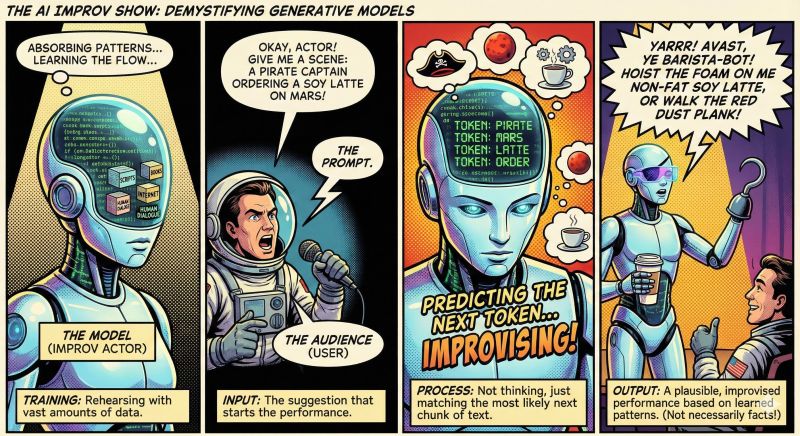
Here's the thing about large language models: they don't "know" things the way you know things. They don't have memories, beliefs, or a database of facts they consult before responding. What they have is patterns. Lots of them. Built from an enormous amount of text data, these models learned to predict what word, phrase, or sentence should come next in any given context. That's it. That's the whole trick.
Think of it like a very well-read improv actor. You give them a prompt, and they build a response that sounds plausible based on everything they've ever read. They're not checking a rulebook. They're not verifying sources. They're improvising, and doing it convincingly.
That framing changes how you should think about working with AI.
When you ask a language model a question, it isn't retrieving an answer. It's generating one. It's producing a response that fits the shape of your question based on statistical patterns in its training data. Most of the time, that response is useful. Sometimes it's brilliant. But sometimes it confidently produces something that sounds right and is completely wrong. Not because it malfunctioned, but because generating a plausible response and generating a correct response are not the same thing.
This is why people who understand how these tools work use them differently than people who don't.
If you know that an AI is pattern-matching rather than fact-checking, you start treating its outputs as drafts rather than verdicts. You use it to generate a first pass, brainstorm a direction, or speed up a task you already understand. You verify anything important before acting on it. You bring your own judgment to the table.
If you don't know how it works, you might trust it too much in the wrong moments, or distrust it too much in the moments where it could genuinely help you.
The analogy that actually clicks for a lot of people: imagine the AI went on the world's longest reading binge. It absorbed books, articles, forums, code repositories, academic papers, and a lot of other things. Now it's sitting across from you, and when you ask a question, it answers the way a very confident, well-read person would. Not necessarily a verified expert. A well-read person.
That's a genuinely useful thing to have access to. It can save you hours on tasks that used to require starting from zero. It can give you a solid foundation for research, writing, analysis, or problem-solving. It can help you work faster and think through problems more thoroughly.
But it works best when you understand what it is. Not a search engine. Not a database. Not an oracle. A sophisticated pattern-completion system that happens to be very good at sounding like it knows what it's talking about.
Once that clicks, the way you work with AI changes. You stop asking it questions you'd ask Google and start giving it tasks you'd give a smart collaborator. You stop expecting it to be right about everything and start using it as a starting point. You bring more of your own expertise to the conversation, not less.
The teams that are getting the most out of AI right now are not the ones using it the most. They're the ones who understand what they're actually working with.
That distinction matters more than most people realize, and it starts with understanding the basics of how these tools work.
Phizenix works with organizations navigating the shift toward AI-assisted work. If your team is trying to figure out where AI fits, and how to use it in a way that actually holds up, we're happy to talk.